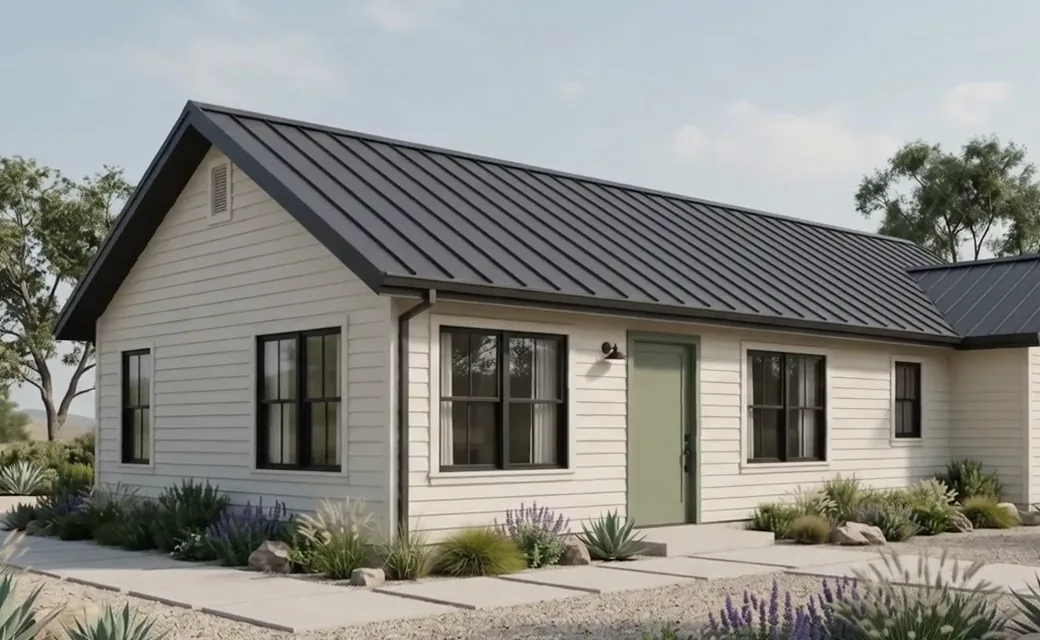

Score your house before a wildfire tests it.
Answer questions about your roof, vents, eaves, walls and the first five feet of your yard.
Get a 0 to 100 hardening score and a detailed report of strengths, gaps, and recommended next steps to improve your preparedness.
Five minutes. No account, no cost.
What we look at
The ten things, in detail
Open any element for what it is, why it matters, what good looks like, how it is judged, and the question we will ask you.
Measure C1
Roof
- What it is.
- The outer covering of your home, from the ridge down to the edge, together with the layer directly beneath it. Composition shingle, tile, metal, and wood shake are all roof coverings, and they behave very differently under an ember shower.
- Why it matters.
- The roof is the largest surface your house presents to the sky, so it catches whatever falls. Embers gather where the roof slows them down, in valleys, behind chimneys, and along the lower edge. A covering that will not ignite gives those embers nothing to start with. A covering that will ignite gives a fire a hold on the highest and hardest to reach part of the building.
- What good looks like.
- A Class A rated roof covering in sound condition, with no missing or lifted pieces, no gaps at the ridge or edge, and no accumulated debris sitting on it.
- How it is judged.
- Roof coverings are rated by fire test under ASTM E108 and UL 790. The Class A rating is the highest of the three, and it is earned by passing an intermittent flame test, a flame spread test, and a burning brand test on the assembly. California insurers who price on wildfire risk are required to account for the roof under 10 CCR 2644.9(d)(1)(B)2.a.
- What we will ask you.
- "What is your roof made of, and do you know whether it carries a Class A fire rating?"
Methodology
Where this comes from
Built on California rules, useful anywhere embers land.
The measure set is built on the California statute and the wildfire mitigation measures its insurers price on, because California has the most developed wildfire mitigation rules in the country.
What a hardened home looks like does not change at a state line. Embers behave the same way in Colorado, Texas or Oregon, so the score applies anywhere with fire exposure.
The shortcuts do change at a state line. Address prefill draws on California datasets, so a homeowner outside California answers more questions and sees no local hazard comparison.
Fire hazard and inspection data: CAL FIRE. Geocoding: US Census Bureau.
COMPANION TOOLS
Your house is only part of the picture.
Home hardening covers the building: the roof, the eaves, the vents, the windows, the walls. Defensible space covers the ground around it, the vegetation and fuel that carry fire toward the structure. Insurers credit both. The evidence is emphatic that hardening a building does very little if there is continuous fuel against the walls, which is why we ask about the five feet closest to your house here. For everything beyond that, use the Defensible Space Score.